
Midnight Jewel Blackberries: The Thornless Bramble That Fruits Twice a Year
Midnight Jewel blackberries are thornless and fruit twice a year – a heavy summer crop off last year’s canes starting in July, then a second push from this year’s brand-new growth that runs until frost. Berries bigger than your thumb tip, noticeably sweeter than wild canes, no gloves required, from roughly early July into November once established.
Field report #002
The blackberry that doesn’t know when to stop.
| hardy in zones | 5-8 (comfortably covers our 7B) |
| permaculture layer | vining / cane fruit |
| sun | full sun (planted on the sunrise-facing row for max exposure) |
| spacing | 3-4 ft |
| pollination | self-pollinating – one plant is enough to get fruit |
| growing here since | fall 2024 (3rd year in ground, 2nd harvest season as of 2026) |
| first harvest | 2025 – first full growing season after the fall planting |
| edible yield | fresh eating, wine |
| cost to start | $22.99/plant – 6 planted initially ($137.94), 5 more ordered this year |
| propagation | haven’t tried yet – tip layering is the typical method for blackberries, on the list for a future season |
thornless double-cropping culinary trellis-trained
thornless double-cropping (two harvests, one plant) berry size outcompetes Johnsongrass
Would I plant again? YES – my daughters agree, loudly, from the couch, mouths full.
What makes this different from the blackberries already on the property?
We already have a full property’s worth of native blackberries, which is exactly what made planting more of them, on purpose, sound a little crazy to the people who heard about it. But the native stuff comes with real costs: thorns thick enough to need real gloves, and a fruit that runs small and tart with a seed-to-flesh ratio that gets old fast.


Midnight Jewel fixes both problems in one plant. It’s thornless, so picking is a bare-hands job. And the berries are genuinely enormous – bigger than the last digit of your thumb, sometimes stretching past the second knuckle. That size difference is not a small upgrade; it changes how much fruit you walk away with per minute of picking.

The tartness problem turns out to be measurable, not just a feeling. Stark Bro’s lists Midnight Jewel at 11-12% soluble solids with lower acidity than typical blackberry varieties – which, translated out of spec-sheet, means less sharp and noticeably sweeter than what our native canes produce. You can taste the difference in the first bite, but it’s nice to know there’s a number behind it too.
I found this variety researching what to put in a specific row while laying out the food forest. I wanted one row dedicated to high-sun vining and fruiting plants – blackberries, raspberries, and grapes together – and picked the side of the property closest to sunrise so it would catch the most light and stay clearest of the mature trees’ shade. Midnight Jewel was the blackberry that made the cut for that row.
One naming note, since it tripped me up during research: this variety was originally sold as Stark® Black Gem®, and is now listed as Midnight Jewel. I asked Stark Bro’s directly to confirm it’s the same plant under a new name, not a different variety – it is.
Do primocane blackberries really give you two harvests a year?
Yes, and this is the feature that sold me. Most blackberries only fruit on floricanes – second-year canes. You get a green cane the first year (a primocane), leave it alone, and it fruits the following year once it’s become a floricane; then you cut it out before it goes woody and stops producing.
Midnight Jewel does that too, but it also fruits on the first-year primocane itself, in the same season it grows. University extension sources call this “double cropping,” and Stark Bro’s numbers line up with what I’ve watched happen in the row: the floricanes – canes that grew last year – carry the heaviest crop starting in July, and the primocanes – brand new canes growing this same year – start ripening in late August and keep going until frost. Most blackberries ship one release a year; this one runs two. Practically, that means fruit starting in early July (sometimes June, depending on the season) and continuing into November, instead of one shorter window.


That first harvest season, we just picked and picked and picked. It was genuinely a lot of fruit for a plant that had only gone into the ground the fall before – I was fully expecting to wait it out and got fed instead.
How do you keep six-foot canes from taking over your paths?
This is the honest failure story, because every plant on this site has one.
Left alone, Midnight Jewel canes get close to six feet tall, sometimes taller, and they don’t stand up on their own. Without a real plan to manage them, they flop and sprawl across every lane nearby.
My first fix was a Florida weave – binding the canes together with twine against a single wire, the way you’d stake a young tree. I tried it, re-tried it, re-wove it more than once. It never worked the way it’s supposed to. Mostly what it did was compress the canes together and stress the plant, without actually keeping the row upright or usable.
What actually worked came out of parts I already had lying around: spare T-posts and extra orchard wire. I drove the T-posts into the ground in a V shape – narrow where it meets the ground near the plants, opening out to roughly an 80-degree angle – then ran wire across that V at a few heights (high, low, and middle), plus more wire running horizontally across the row to break it into sections. That grid gives the canes somewhere specific to grow into, upright and off the ground, without tying them into a single choked bundle. The Florida weave failed because it fought the canes; the V gives them somewhere to want to go. It cost almost nothing beyond materials I already owned; the only real labor was driving the angled posts with a post driver, which is its own small arm workout and a much better time than fighting a Florida weave for the third time.

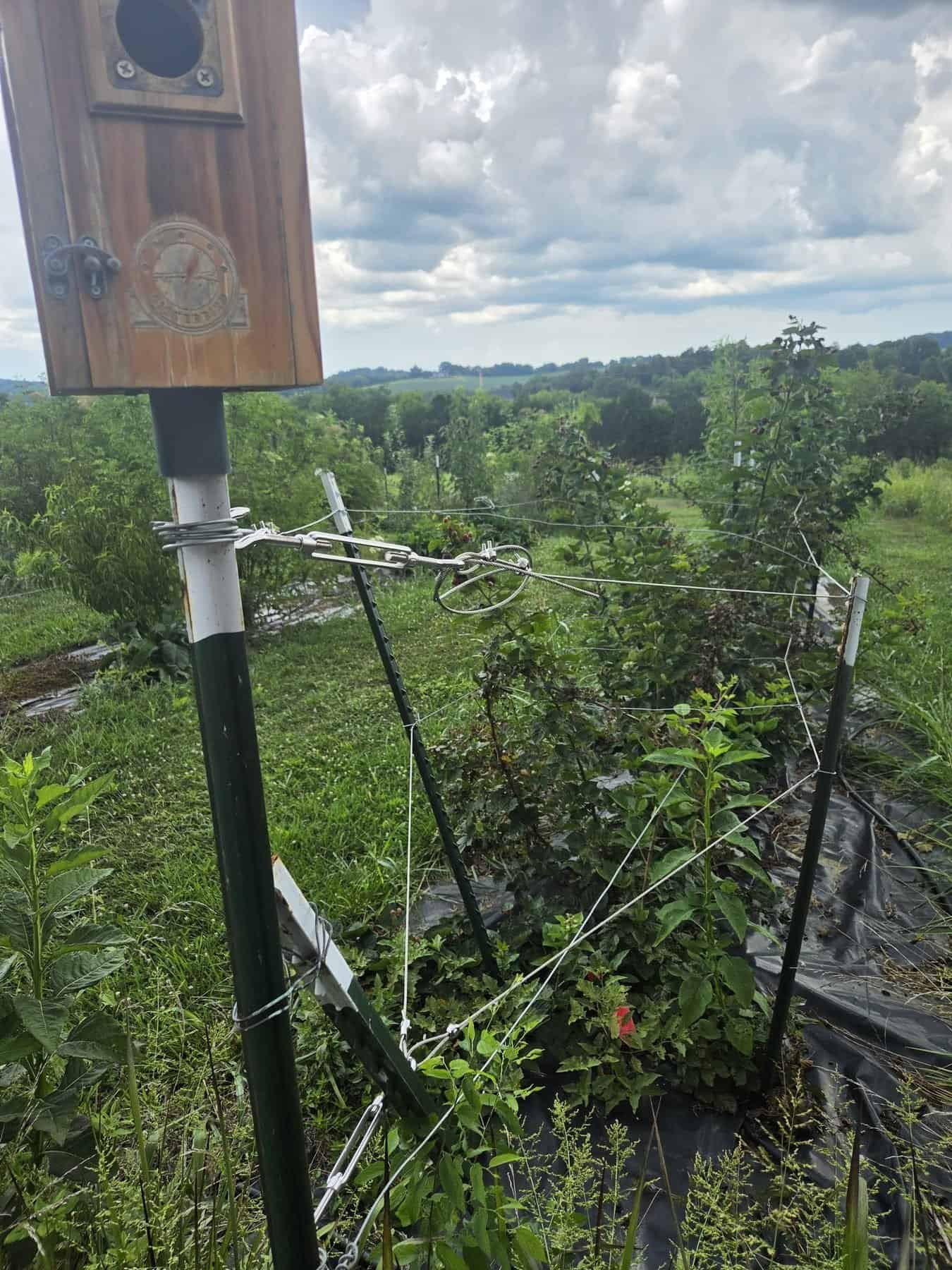
This year – our third season in the ground, second harvest coming – I need to open up the plastic mulch a bit more to give the roots room. The canes send runners underneath the plastic hunting for any gap of light, which happens to be useful: those runners outcompete the Johnsongrass that gives most other beds on the property trouble.
Who’s actually eating all these blackberries?
Everyone, constantly. My two daughters raid the patch on sight, and more than once I’ve come inside to find both of them flopped on the couch, thoroughly stuffed, groaning something like “can’t talk, ate too many blackberries” when asked what’s wrong. Eugene the pig gets his share too – he’s up in the orchard helping with weeding often enough that a handful of blackberries has become a standard thank-you.

The rest just get eaten fresh, and they clear the bar for size and sweetness that matters most around here: Sunny’s approval. We’re planning a second batch of homemade wine with this year’s harvest – the first batch used our native blackberries, and given how much sweeter Midnight Jewel runs, I’m expecting this one to turn out better.

How tough is it, really?
No complaints yet. We’ve had no issues from rain, summer heat, or winter cold since planting. Maintenance is close to nothing beyond picking the fruit and occasionally gathering stray canes back into the wire training system. And here’s a correction I owe the plant, not just the reader: it isn’t actually the aggressive spreader the trellis story makes it sound like. It’s vigorous, and it wanted more sun and elbow room than my plastic mulch was giving it – which is entirely a me problem. Shame on me for making it wait two seasons for a fix. This year it finally gets the room it’s been asking for.

We started with six plants. I ordered five more this year, which is either proof the trellis system works or proof I have no self-control around a good blackberry – probably both, and Sunny would bet on the second one first.
This is the second entry in the running Field Reports series – if you haven’t already, Field Report #001 on Egyptian walking onions covers a completely different kind of self-propagating headache.

What I used
- Midnight Jewel blackberry plants – Stark Bro’s. Worth noting: it’s a Stark Bro’s exclusive and tends to sell out mid-season, so order early if you want it this year.
- T-posts and orchard wire (had both on hand already)
- A post driver, for driving the angled posts
- Plastic mulch (already in place across the row from initial planting)
Sources and further reading
- Primocane Fruiting Blackberries – Alabama Cooperative Extension System
- Plant Growth – Southeast Regional Caneberry Production Guide, NC State Extension
- Midnight Jewel Blackberry Plant – Stark Bro’s (product reference, not an affiliate link in this post)
Want the next Field Report when it drops? Join the newsletter – one email a week, real numbers, no fluff.
