
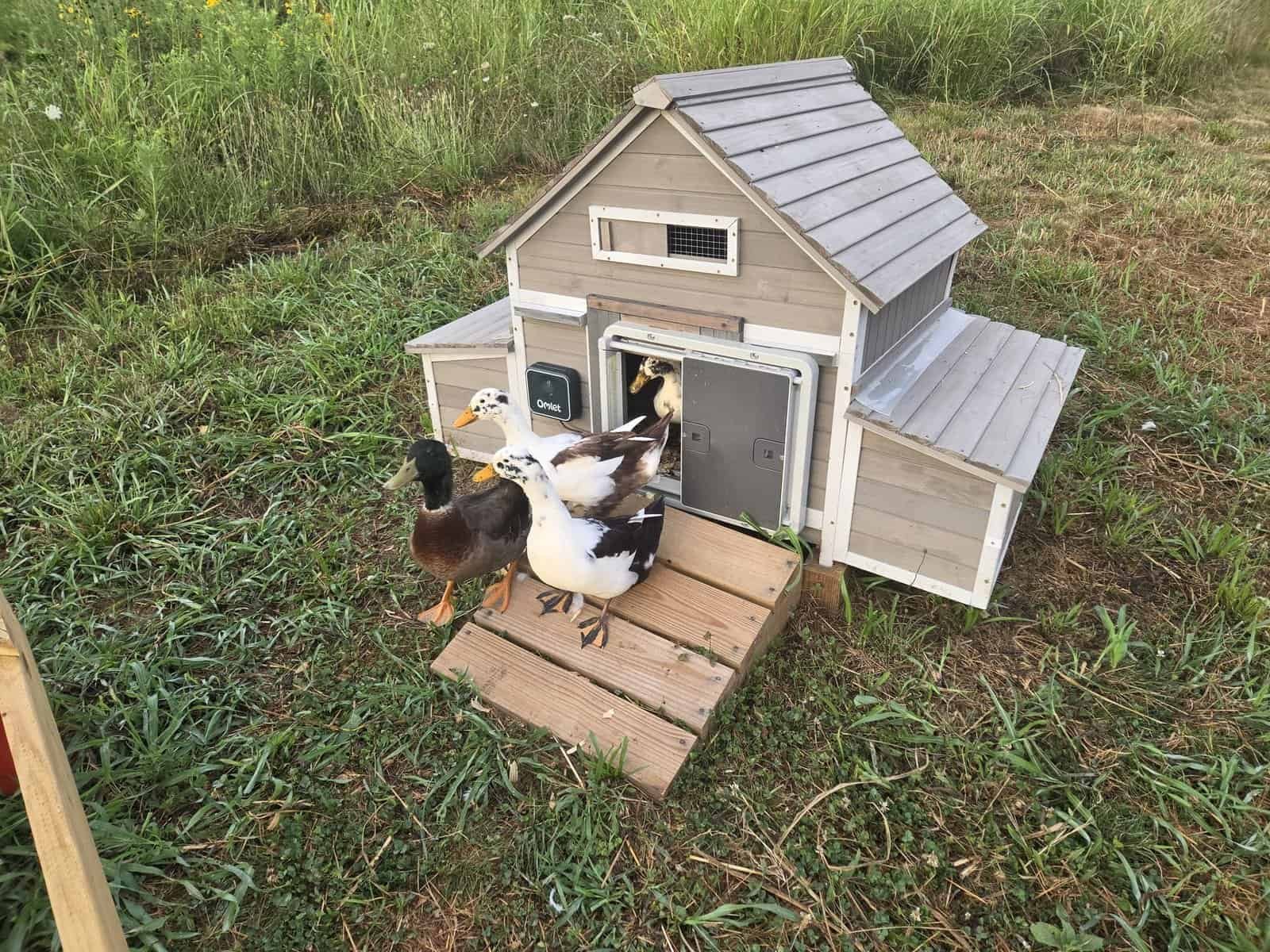
Automating Duck Care: A Smart Door, Timed Feeding, and a Pig Defense System
You can automate most of a duck flock’s daily care with three pieces of equipment: an automatic duck coop door, a motorized feeder on a schedule, and a gravity waterer that controls the mess. Ours run themselves well enough that the ducks handle mornings without us – and the only system failure so far was a pig.
This post contains affiliate links to products I actually use. If you buy through them, I may earn a small commission at no extra cost to you.
Why automate ducks at all?
The ducks earn their place here four ways: they patrol fire ants and ticks, they’ll give us eggs (any week now – we’re two and a half months in and I check like it’s Christmas), and they are, honestly, a delight. The fourth purpose is the reason for this post: I wanted them living in zone 1 – permaculture’s innermost ring, the space you touch every day – without demanding zone 1 levels of my time.
I hold a strong opinion here: maintenance is the enemy of expansion. Every recurring chore I take on is capacity I can’t spend building the next system. So anywhere automation has a real return over time, I’ll pay for it once instead of paying for it daily. Ducks were the test case. There was also a second requirement hiding underneath: I want to be able to leave. A weekend away, even a week, without wondering whether the animals are cared for. That means automation with redundancy – an app, my Home Assistant setup, and automated routines checking each other – not a single gadget with a prayer attached.

The flock, briefly
Four ducks: Eliza, Peggy, and Angelica – yes, the Schuyler sisters – plus Mexi, who came to us as an emergency replacement and turned out, months later, to be a drake. I’m a complete amateur at sexing waterfowl, and the hatchery’s guarantee only covered the original three. The full story of how we chose this breed, what went wrong with the first hatching, and how Mexi joined the family is its own post coming soon. Today is about the machinery around them.

The stack
| Component | What we use | Job | Cost |
|---|---|---|---|
| The coop itself | Amazon coop (sold for chickens – see below) | The chassis everything else bolts to | $166.99 |
| Coop door | Omlet Smart Autodoor | Opens and closes on schedule; app + Home Assistant control | $299 |
| Feeder | Omlet Smart No Waste Chicken Feeder | Opens on a timed schedule – feeding windows, not free-feeding | $229 |
| Water | Omlet Insulated Stay Clean Chicken Waterer (3 gallon) | Gravity-fed, mess-limiting, insulated against both freeze and heat | $99 |
| Pig defense | Two treated 2x6s + scrap 4x4s | Keeps a very hungry boy out of the duck feed | ~$21 |
Prices are list at time of writing; with our local sales tax the Omlet automation stack landed at roughly $690 out the door. Add the coop and the lumber and the whole duck housing-and-automation system came in right around $900 – a number I intend to defend with an ROI follow-up once there are eggs to count.
I’ll say the honest part out loud: the Omlet gear cost more than I originally intended to spend. I stuck with it because it hit the exact use case – scheduled operation, physical controls, and real smart-home integration – and cheap gear that misses the use case is the most expensive kind.
The coop: when buying beats building
Confession from a man with a woodshop: I was going to build the duck house. I designed it, priced the lumber and hardware, made the cut list – and then compared my parts total against ready-made options on Amazon and lost the argument with myself. The bought coop was significantly cheaper than my own materials, before counting a single hour of labor.
So I bought it, and I’ll give you the honest grade: it’s okay. Assembly was fine, it does the job, and it will last a couple of seasons – not a couple of decades. But here’s why I’d make the same call again: speed mattered more than permanence. Young ducks in your house is a temporary situation that feels less temporary every day, and the bought coop got them outside, housed, and into the routine that everything else in this post depends on. A perfect coop next year helps nobody this year.
The plan is to build their forever home eventually – sturdier, winter-ready, designed around what these two seasons teach me. That build will be its own post. Meanwhile: sometimes the right engineering decision is clicking “add to cart,” and I say that through only slightly gritted teeth.
Buying chicken gear for a duck operation
Here’s a market reality nobody tells you: almost everything in the poultry aisle is designed for chickens. Duck-specific products exist, but if you want variety and quality, you’ll mostly be adapting chicken equipment – our coop is literally sold as a chicken coop, and so is every piece of the Omlet gear. It all works fine, as long as you translate for three differences.
First, ducks don’t hop. A chicken thinks nothing of a vertical jump to a roost or a feeder lip; a duck wants a ramp and a gradual grade, and will simply decline anything that requires climbing. When you evaluate any product, ask “can a low-slung bird with no vertical game walk into this?” Second, everything about water access runs through the bill: ducks need to submerge it completely, which rules out a lot of chicken-first designs on its own. And third – the one that surprised me most – water placement changes how much they eat. More on that next, because it deserves its own section.
The automatic duck coop door: my one buy-twice mistake
My first door was the Run-Chicken Eternal, a solar automatic door. It worked, and solar power is a genuine advantage – no battery swaps. But it had two dealbreakers for how this farm runs: no physical interface at all (app-only control, which means a dead phone or a flaky connection stands between you and your coop) and no integration with Home Assistant, which is the nervous system of this property. I don’t want six apps; I want one dashboard.
So I switched to the Omlet Smart Autodoor: Wi-Fi and Bluetooth, opens by ambient light or time schedule (I use time), tracks its own open/close history, and connects to Home Assistant through a community integration. The trade-off is real – it runs on batteries where the Run-Chicken sipped sunlight – but I’ll take a battery swap a couple times a year in exchange for the whole system speaking one language. Lesson for your own buying decision: list your dealbreakers before you shop, not after the first unit is installed.
Fair warning if you’re bolting one of these onto a budget coop: expect a retrofit. The Omlet door was slightly too wide for our coop’s front, and the opening slightly too short, so the mounting job took some scrap lumber, a little framing, and gray paint to blend it in. Nothing difficult – look closely at the photos and you can spot the surgery – but budget an afternoon and don’t expect bolt-on perfection between two products that have never met.

The feeding program (this is the actual secret)
The feeder is motorized and opens on a schedule, and the schedule is where the magic lives – because what I’m really programming isn’t a feeder. It’s duck behavior.
The ducks come out of the coop hungry in the morning. No breakfast waiting. A hungry duck is a motivated forager, and motivated foragers spend the day working the property for protein – which is to say, eating my fire ants and ticks. Then, in the afternoon, the feeder opens for a three-hour window of unrestrained eating, so they end the day full, content, and inclined to cooperate.
That last part matters more than I expected: ducks who associate the evening with a full belly and a routine are trainable. Ours sometimes put themselves to bed. Sometimes they need walking home – the first few times took real coaxing – but they’re creatures of routine, and the routine is doing more of the work every week.

One warning from the multi-species department: coordinate your feeding times across every animal you keep. We learned that unsynchronized meals produce a food-crime economy – the pig wants the duck food, the ducks want the pig food, and the dogs, for reasons known only to dogs, want to lick the dust out of the pig’s trough. Feed everyone at once and the whole black market collapses.
Water: ducks are gloriously disgusting
Nobody warned me how fast ducks destroy a water source. Give them an open pan and within a day the pan, and the ground around it, is green and foul. It’s not a flaw – it’s what ducks are – but it’s a maintenance bomb if you let it be one.
Here’s the biology that shaped the whole setup, and it explains something I noticed before I understood it: my ducks eat noticeably more feed when water is right there with it. That’s not preference – it’s plumbing. Ducks have almost no salivary glands, so water is literally how they swallow: a bill of feed, then a dip of water to wash it down, bite after bite.
No water nearby means uncomfortable, risky eating – dry feeding can cause choking – so they quietly eat less. If your ducks seem off their feed, check the water before you blame the feed. The rule that falls out: water lives next to food, always, no exceptions.
The bill work matters beyond swallowing, too: ducks flush their nostrils, sinuses, and eyes by submerging that bill – it’s their whole self-cleaning system – so a chicken nipple-waterer alone doesn’t cut it. And the third requirement: the water supply needs to be defended from duck enthusiasm.
The Omlet Insulated Stay Clean Chicken Waterer is technically a chicken product, but it handles both: it ships with cup ports (the gravity-fed pools that let a bill get properly wet) as well as nipples, it’s sealed and light-blocking so algae never gets started, the domed lid means nobody roosts on – or poops in – the water supply, and the insulation keeps it flowing in a freeze and cool in our summers. Multiple gallon sizes, a water-level window so you can see the state of things at a glance, and refills without drama. It could not be better matched to what ducks actually do to water.

The Eugene incident
Every system meets its adversary. Ours weighs a couple hundred pounds and lives here.

Eugene, our house pig, discovered that the duck feeder contained food, and that the feeder was, from a pig’s perspective, a toy with a prize inside. He played soccer with it. He rolled it down the hill. He jammed the mechanism, broke several components, and distributed feed across a startling radius. This happened more than once, because I am apparently a slow learner and he is a very hungry boy.
The fix is my favorite kind of engineering: a pig defense system built from two treated 2x6s ($10.28 a board) and 4×4 posts that cost nothing, because they came off my scrap rack. Quick sermon: store your offcuts. I keep any piece of lumber longer than six inches, organized on a rack in the shop, and it means half my small builds get pieced together from wood I already own. (The rack itself is a build I’m unreasonably proud of – future post.)
The defense system is a simple braced square, corner posts holding it about eight inches off the ground – high enough that the ducks stroll underneath to reach their feeder, low enough that Eugene can’t get purchase to shove or flip it. Corner braces keep it square when he tries anyway.

Here’s the design insight, and it applies to more than pigs: I didn’t make the feeder pig-proof. I made it not worth the effort. Eugene is technically strong enough to wreck that frame – but the work now exceeds the reward, especially because we feed him at the same time the duck feeder opens. By the time he’s curious, he’s already fed and in his happy place. He snuffles the perimeter, accepts the geometry of his situation, and lies down beside it with theatrical dejection. Security through incentive design. It works on pigs.

The nerd layer: Home Assistant
For the technically inclined, this is where it compounds. The Omlet gear connects to Home Assistant through a community integration, which gives me the door’s current state, feed level, and the open/close history on the same dashboard as everything else on the property. In our system the devices are registered as Duck Dungeon (the door) and Duck Trough (the feeder), because if you can’t have fun naming your infrastructure, why have infrastructure. As I write this, the Trough reports itself 80% full with 8 days of feed remaining – which is exactly the number a person checks from a hotel room, and exactly why this setup exists.

Cross-referenced with our cameras, I can confirm from anywhere whether the ducks actually went to bed or are still out prowling – which matters, because duck bedtime turns out to have a confounding variable.
The ducks are social. Specifically, they want to sleep wherever Eugene is. If the pig is sleeping on the porch, duck bedtime compliance drops through the floor; if he’s inside, they file off to the coop like professionals. It’s a sleepover economy, and no automation vendor lists “pig location” as an input. For now, the system handles the mechanics and I supply the common sense. (How we use cameras to run the farm is its own future post – it’s become a bigger tool than I expected.)

What version-next fixes
Eggs, hopefully – that’s on the ducks, not the automation. Better self-directed bedtime is the real training project, and I suspect the answer involves the routine deepening with age, or possibly negotiating with the pig. And I’ll keep publishing what the system costs versus what it saves – because “automation with ROI” is a claim, and claims get measured here.
What I used
Everything below also lives on the Essential Resources page, alongside the rest of what runs this place.
- Amazon coop – $166.99; honest grade: okay, a couple of seasons’ worth
- Omlet Smart Autodoor – $299
- Omlet Smart No Waste Chicken Feeder – $229
- Omlet Insulated Stay Clean Chicken Waterer, 3 gallon – $99
- Run-Chicken Eternal – the door I replaced; solid solar option if app-only control fits your life
- Pig defense: two treated 2x6s ($10.28 each), scrap 4×4 posts, exterior screws
Want the next system write-up when it drops? Join the newsletter – one email a week, real numbers, no fluff.
